
Commercial refrigeration manufacturers face a complex set of challenges. From maintaining consistent temperatures and improving energy efficiency to simplifying assembly and managing production demands, every component plays a role in the performance of the finished system.
One component that deserves closer consideration is the refrigeration door frame.
Traditionally, manufacturers have relied on metal and pultruded fiberglass profiles for structural and functional applications. While these materials offer established performance benefits, advances in engineered thermoplastic extrusion are creating new opportunities to rethink how refrigeration frames and related components are designed, manufactured, and assembled.
The opportunity extends beyond material substitution. It begins with engineering a profile around the requirements of the application.
Greater Design Freedom Through Thermoplastic Extrusion
One of the most significant advantages of thermoplastic extrusion is the ability to incorporate multiple functional features into a single continuous profile.
Traditional assemblies may require separate components for attachment, sealing, finishing, or other functional requirements. Depending on the application, engineered thermoplastic profiles can consolidate several of these functions into one customized geometry.
For commercial refrigeration manufacturers, this can include:
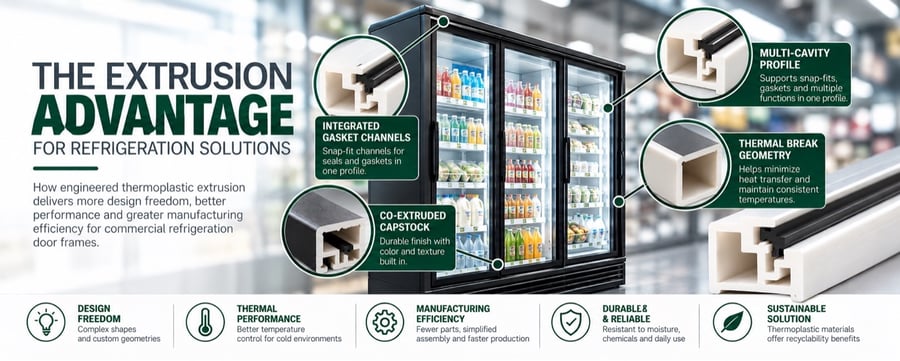
- Multi-cavity profiles: Integrating channels for gaskets, seals, and snap-fit connections.
- Complex geometries: Designing cross-sections that accommodate specific dimensional and functional requirements.
- Co-extruded capstock: Incorporating decorative or functional surface layers, including color and texture, during production.
- Integrated attachment features: Reducing the need for additional brackets, fasteners, or secondary components.
Pultruded fiberglass profiles offer excellent strength and stiffness in appropriate applications, but their manufacturing process can impose limitations on certain intricate geometries and integrated features.
Metal profiles, including aluminum, can also be manufactured into complex shapes. However, some applications require additional finishing, insulation, attachment components, or assembly operations.
Thermoplastic extrusion gives engineers another design option, particularly when several functions can be combined within the same profile.
The result is an opportunity to simplify the finished assembly without compromising its intended function.
Engineered Performance for Demanding Refrigeration Environments
Design flexibility is only part of the equation. Commercial refrigeration components must also perform reliably in environments characterized by temperature differences, humidity, repeated door operation, and frequent cleaning.
Selecting the right thermoplastic material and profile geometry is essential to achieving the necessary performance.
Thermal Performance
Thermal transfer is an important consideration in refrigeration door frames and surrounding assemblies.
Metals such as aluminum conduct heat relatively efficiently. While metal provides valuable structural properties, additional thermal breaks or insulating components may be necessary to reduce heat transfer.
Many thermoplastics have substantially lower thermal conductivity than aluminum, making them attractive candidates for applications where thermal separation is important.
With an appropriately engineered profile, manufacturers may be able to incorporate thermal-break functionality directly into the component design.
Actual system-level energy performance depends on the complete assembly, including glazing, seals, installation, and operating conditions.
Durability and Environmental Resistance
Commercial refrigeration environments expose components to moisture, condensation, cleaning agents, and repeated use.
Engineered thermoplastics can provide resistance to corrosion and moisture-related deterioration, depending on the selected material and exposure conditions.
Unlike unprotected ferrous metals, thermoplastics do not rust. Certain formulations can also offer useful impact resistance, chemical resistance, and durability for demanding applications.
Dimensional Performance
Dimensional consistency is critical when profiles must accommodate gaskets, glazing, attachment features, and other components.
Material selection, tooling design, wall thickness, processing conditions, and thermal expansion characteristics all influence the dimensional performance of an extruded profile.
By considering these requirements early in development, manufacturers can create profiles engineered for the fit, function, and operating conditions of the finished assembly.
The objective is not simply to select the strongest material available. It is to select a material and geometry that deliver the performance the application requires.
Smarter Manufacturing Starts with the Profile
A well-designed extrusion can influence more than the performance of an individual component. It can also affect how efficiently the entire assembly is produced.
For refrigeration manufacturers evaluating alternatives to metal or pultruded profiles, the manufacturing process presents several potential opportunities.
Fewer Secondary Operations
Co-extruded finishes can incorporate color, texture, or other surface characteristics directly into a profile.
In suitable applications, this can reduce or eliminate separate painting and finishing operations, helping streamline the manufacturing process.
Simplified Assembly
Integrating snap-fit connections, gasket channels, and other functional details into the extrusion can reduce the number of individual components required.
Fewer parts may mean fewer handling steps, fewer fastening operations, and a more straightforward assembly process.
Production Efficiency and Tooling Flexibility
Thermoplastic extrusion can support efficient continuous production, with the potential for higher line speeds than certain pultrusion processes, depending on the materials, geometry, and quality requirements.
Tooling requirements and lead times also vary by application. For suitable profile designs, thermoplastic extrusion may offer opportunities for efficient tooling development, design modifications, and scalable production.
These advantages should be evaluated against actual production volumes, tolerances, material specifications, and downstream processing requirements.
Lifecycle Considerations
Thermoplastic profiles can also offer opportunities for material recovery and recycling, depending on their composition and available recycling infrastructure.
Long-term performance, maintenance requirements, material efficiency, and end-of-life considerations should all be part of the engineering evaluation.
Comparing Thermoplastic Extrusion, Pultrusion, and Metal
No single material or manufacturing process is ideal for every application.
Metal remains an important choice where high stiffness, strength, or temperature resistance is required. Pultruded fiberglass offers valuable mechanical properties, particularly in applications benefiting from continuous fiber reinforcement.
Engineered thermoplastics become especially compelling when manufacturers need to balance design complexity, thermal characteristics, environmental resistance, and assembly efficiency.
The decision should consider the complete component and its role within the finished refrigeration system, rather than focusing exclusively on the initial material price.
In some applications, the greatest advantage comes not from replacing an existing profile with an identical thermoplastic version, but from redesigning the component to take full advantage of the extrusion process.
Engineering Better Refrigeration Solutions
As commercial refrigeration systems continue to evolve, manufacturers have opportunities to reconsider established material choices and component designs.
Engineered thermoplastic extrusion offers a versatile approach to developing profiles that integrate functional features, address application-specific performance requirements, and simplify downstream manufacturing.
At Engineered Profiles, we work with manufacturers to explore custom extrusion solutions built around their unique design, material, and production needs.
Whether the goal is to improve thermal performance, integrate multiple features into one profile, or evaluate an alternative to an existing metal or pultruded component, the process begins with understanding what the application needs to accomplish.
The next opportunity in refrigeration design may begin with rethinking the profile.
Ready to explore a custom extrusion solution?
Connect with the Engineered Profiles team to discuss your application and discover how engineered thermoplastic extrusion could support your next project.